

This is one of the most common questions people ask when they start getting serious about buying a home and it does not have a single right answer. The better loan depends entirely on your credit profile, how much you have saved, how long you plan to stay in the home, and what your monthly budget actually looks like. Anyone who gives you a definitive answer without knowing those things is guessing.
What you can do is understand how these two loan types actually differ, which factors push a buyer toward one over the other, and how to think through the comparison for your specific situation. That is what this is about.
The Fundamental Difference
FHA loans are backed by the federal government through the Federal Housing Administration. That government guarantee reduces the lender’s risk, which is why FHA loans can accept lower credit scores and smaller down payments than conventional financing. The trade-off is that the FHA charges mortgage insurance that stays on the loan longer and costs more in certain scenarios.
Conventional loans are not government-backed. They follow guidelines set by Fannie Mae and Freddie Mac, and lenders take on more of the risk which means they apply stricter standards to borrowers who do not compensate with a strong credit profile or larger down payment. The upside is that conventional mortgage insurance is more flexible and, in many cases, can be removed once you reach sufficient equity.
Understanding this basic structure answers a lot of the downstream questions about why the programs differ the way they do. The mortgage basics page has a solid overview if you want to go deeper on how government-backed versus conventional financing works in practice.
Credit Score: Where the Comparison Gets Real
FHA allows credit scores as low as 580 for the standard 3.5% down payment tier, and scores between 500 and 579 can still qualify with 10% down. Conventional loans typically want to see 620 as a floor, with meaningful pricing improvements as you climb toward 700, 720, and above.
If your score is in the 580 to 619 range, FHA is almost certainly your only realistic option between the two. At 620 to 659, you technically qualify for conventional but you may find FHA pricing is more competitive. Above 680 and especially above 720 conventional financing starts becoming genuinely competitive and sometimes clearly superior depending on your down payment. This is one of the clearest variables in the FHA versus conventional comparison.
Down Payment: How Much You Have Changes Everything
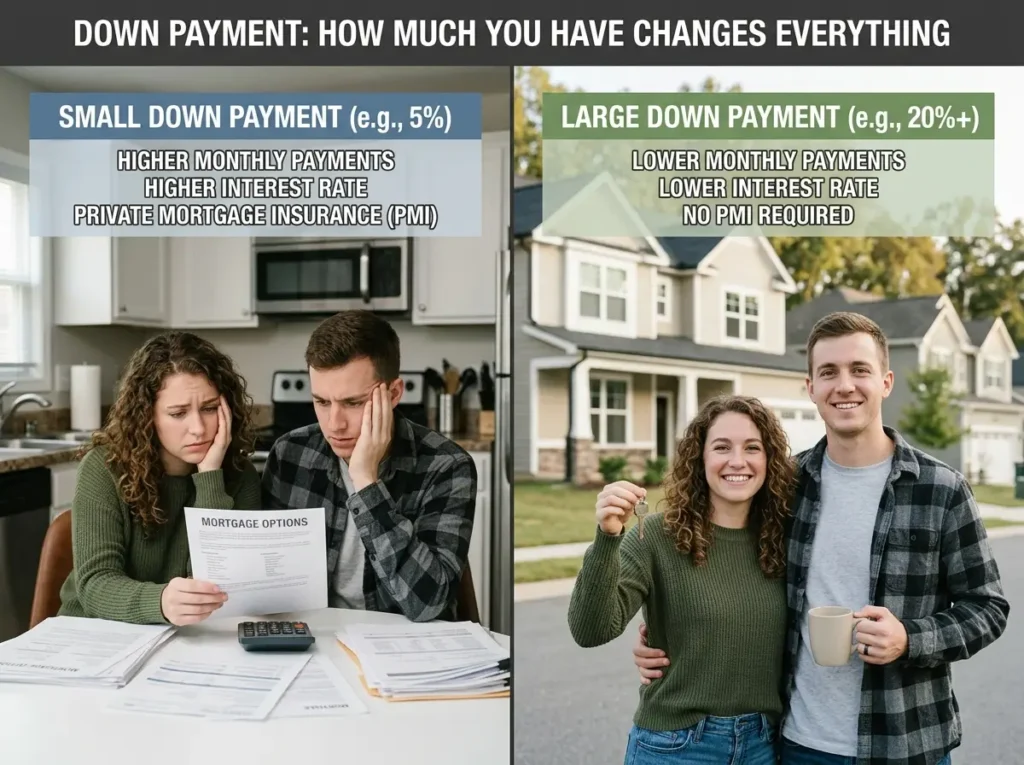
FHA requires 3.5% down with a 580+ score. Conventional loans offer a 3% down option through programs like Fannie Mae’s HomeReady or the Conventional 97, but those products come with specific income limits and requirements. The standard conventional down payment expectation sits at 5% to 20% depending on the loan and the lender.
Where it gets interesting is at 20% down. Put 20% down on a conventional loan and you eliminate private mortgage insurance entirely no monthly insurance payment at all. That changes the monthly payment math significantly compared to an FHA loan at any down payment level, where mortgage insurance is required regardless of how much you put down.
Our loan programs page breaks down the specific requirements for both loan types so you can see where your numbers land within each program’s guidelines.
Mortgage Insurance: The Detail Most Buyers Miss
This is where the comparison gets more nuanced than most people expect. FHA loans carry two layers of mortgage insurance an upfront premium of 1.75% of the loan amount that most borrowers roll into the loan, and an annual premium divided into monthly installments. That annual premium stays on the loan for its entire life if you put less than 10% down. For the life of the loan. That is a significant long-term cost.
Conventional PMI, by contrast, can be removed once your loan-to-value ratio reaches 80% either through payments, appreciation, or a combination of both. You can request cancellation at that point, and lenders are required to remove it automatically at 78% LTV. For buyers who expect their home to appreciate or plan to make extra payments, this flexibility has real value that compounds over time.
If you are comparing a 30-year scenario on both loan types, the mortgage insurance difference alone often tips the math in favor of conventional for buyers who can qualify on credit and afford slightly more upfront.
Loan Limits and Property Types
FHA loan limits vary by county and are set by the federal government annually. In high-cost areas like Orange County, those limits are considerably higher than the national baseline, which keeps FHA viable for a meaningful portion of the market. Check with your mortgage loan officer for the current 2026 limits applicable to your target area.
Conventional loans have conforming limits set by the Federal Housing Finance Agency. Above those limits, you move into jumbo territory a separate product category with its own underwriting rules. FHA also has its own version of higher-balance loans in high-cost counties.
Property condition is another differentiator. FHA has specific minimum property requirements that the home must meet certain deferred maintenance issues or safety concerns can complicate an FHA transaction that a conventional loan would sail through without issue. Fixer properties, in particular, are generally easier to finance conventionally.
Which One Actually Costs Less Over Time
Running a true apples-to-apples comparison requires actual numbers your loan amount, your credit score tier, your down payment, and current market rates on both products. In general terms, here is how it tends to shake out.
Below 620 credit: FHA is the only option between these two. Between 620 and 679: FHA and conventional are often comparable, with FHA sometimes edging ahead on rate but conventional potentially winning on mortgage insurance flexibility. Above 680 with 10% or more down: conventional frequently produces a better long-term outcome because of the mortgage insurance removal option. Above 720 with 20% down: conventional wins clearly in most scenarios.
But those are generalizations. Your pre-qualification conversation should include a side-by-side comparison of both programs at your actual numbers not generic assumptions.
When FHA Is the Clearly Better Choice

FHA makes the most sense when your credit score is below 660, when you have limited savings and need the lowest possible down payment, when you are relying on gift funds to cover a significant portion of your upfront costs, or when your debt-to-income ratio is at the higher end of what lenders accept. The flexibility of the FHA program is genuine and meaningful for buyers in these situations.
It is also worth remembering that the FHA loan program allows sellers to contribute up to 6% of the purchase price toward your closing costs a higher ceiling than conventional loans typically allow. In a negotiation where the seller has room to contribute, that difference matters.
When Conventional Is the Clearly Better Choice
Conventional financing wins when your credit score is above 680, when you can put 10% or more down, when you want the option to eliminate mortgage insurance without refinancing, or when you are buying a property with condition issues that might not meet FHA standards. It is also the right tool for second homes and investment properties where FHA is not even an option.
The competitive rates and fees page gives you a starting point for understanding how pricing differences between these products play out at current market rates.
The Honest Answer
For first-time buyers with moderate credit and limited savings, FHA is often the most accessible and practical path. For buyers with stronger credit and more flexibility on the down payment, conventional frequently produces better long-term economics. And for many buyers sitting in the middle, the comparison is genuinely close enough that running actual numbers on both is the only way to know for certain.
Contact Nathan Carpenter today and get a real side-by-side comparison for your specific situation no guesswork, just the numbers.
Frequently Asked Questions
Can I switch from an FHA loan to a conventional loan later?
Yes refinancing from FHA to conventional is a common strategy once you have built sufficient equity and improved your credit score. Many buyers use FHA to get in the door and refinance into conventional once they cross the 20% equity threshold to eliminate mortgage insurance.
Is the FHA loan only for first-time buyers?
No. FHA loans are available to any buyer who has not owned a primary residence in the past three years, regardless of whether they previously owned a home. Repeat buyers returning to the market after a gap qualify just as first-time buyers do.
Does a conventional loan always require 20% down?
No conventional loans are available with as little as 3% down through specific programs, and 5% down is common. The 20% figure matters primarily because it eliminates the requirement for private mortgage insurance, which reduces your monthly payment significantly.