

Buying a home in Orange County can feel overwhelming, especially when you are trying to find a mortgage that fits your budget. For many buyers, FHA loans can provide an affordable route to homeownership because they typically feature more flexible qualification standards than most conventional mortgages and much lower down payment options.
No matter if you are buying your first home or re-establishing your financial future, the right lender can significantly simplify the process. A mortgage professional will go over your financing options, help prepare your application, and walk you through everything from preapproval to closing.
This guide explains the way FHA loans work, in terms of who they make more sense for (versus a traditional loan) and how working with an experienced FHA Loan Lender in Orange County makes the process more transparent and less daunting.
Quick FHA Loan Overview
| Feature | FHA Loan Overview |
| Backed By | Federal Housing Administration |
| Minimum Down Payment | As low as 3.5% for qualifying borrowers |
| Property Type | Primary residence only |
| Credit Requirements | More flexible than many conventional loans |
| Mortgage Insurance | Required on FHA loans |
| Best For | First-time buyers and borrowers seeking flexible qualification standards |
| Quick Note: FHA loans are insured by the Federal Housing Administration, making them less risky for approved lenders while expanding home financing opportunities for qualified buyers. |
What Is an FHA Loan?
The most basic explanation is as follows: An FHA loan is a mortgage insured by the Federal Housing Administration and issued by an approved private lender. Due to the backing of the Federal Housing Administration, lenders may be able to offer more relaxed qualifying standards than many conventional mortgage programs.
FHA loans are often a good fit for buyers who:
- Have limited savings for a down payment
- Are purchasing their first home
- Have moderate credit scores
- Want flexible home financing options
- Need an affordable path toward homeownership
While FHA loans are often the choice of first-time buyers, you do not need to be buying your first home to take advantage of them. If you make the property your primary residence, an FHA loan can also be an option as long as you meet the lender’s standards.
Why Many Buyers Choose an FHA Loan Lender in Orange County

Affordability is a top issue for consumers in Orange County’s highly competitive housing market, where homeownership is an elusive goal; continuing high prices have pushed many home buyers into the rental market. An FHA loan is more accessible to different types of borrowers, which means you can buy a home earlier on the credit journey than with other programs.
Some of the biggest advantages include:
- Lower down payment requirements
- Flexible credit qualification standards
- Competitive interest rates
- Gift funds that may help cover part of the down payment
- Seller concessions that may reduce certain upfront costs
- Multiple loan term options
For many households, these perks make FHA financing one of the most affordable mortgage options around.
How an FHA Specialist Can Help
Working with an experienced FHA loan specialist in California can help you understand your options before you submit an application.
A qualified specialist can assist with:
- Reviewing your financial profile
- Explaining available loan programs
- Preparing required documents
- Estimating monthly payments
- Coordinating the approval process
- Answering questions from application through closing
Having professional guidance often makes the entire mortgage experience far less stressful.
| Pro Tip: Get preapproved for your mortgage loan before you go house shopping so you know how much house you can afford and sellers understand that you’re a qualified buyer. |
FHA Loan Requirements You Should Know
Although FHA loans offer flexible qualification standards, borrowers still need to meet several important requirements before approval.
Typical qualification factors include:
- Stable employment and income
- Credit history review
- Debt-to-income ratio
- Mortgage application documentation
- Property appraisal
- Verification that the home will serve as your primary residence
Some important FHA guidelines include:
| Requirement | General Guideline |
| Minimum Down Payment | As low as 3.5% for qualifying borrowers |
| Occupancy | Home must generally be your primary residence |
| Mortgage Insurance | Required on FHA loans |
| Property Standards | Home must satisfy FHA appraisal requirements |
Ensuring compliance with these guidelines at the outset may prevent some of those painful delays in underwriting and improve the overall borrowing experience.
Understanding FHA Mortgage Insurance
Unlike many conventional mortgages, FHA loans require mortgage insurance, which helps protect the lender if a borrower defaults on the loan.
Mortgage insurance generally includes:
- An upfront mortgage insurance premium paid at closing or financed into the loan
- An annual mortgage insurance premium divided into monthly payments
Although mortgage insurance increases the monthly payment, many buyers find that the lower down payment requirements make FHA financing worthwhile, especially when purchasing a home sooner rather than waiting years to save a larger down payment.
The FHA Loan Process: Step by Step
Being aware of what occurs throughout the mortgage process allows you to get yourself prepared beforehand, and that makes for a more pleasant journey. While every transaction is different, FHA home purchases typically run a similar course.
1. Get Preapproved
Your lender looks at your income, employment history, credit report, and financial documents to calculate how much it believes you may be able to borrow. Before starting the home search, buyers can also get pre-approved for a mortgage to understand their potential budget.
Getting preapproved helps you:
- Understand your home-buying budget
- Strengthen your purchase offer
- Identify potential approval issues early
- Shop for homes with confidence
2. Find the Right Home
After you have been preapproved, you can start looking for a home that fits your needs and also falls in line with FHA property guidelines.
Your lender and real estate agent can help ensure the home is likely to qualify before moving forward.
3. Submit Your Loan Application
Once your offer is accepted, you submit the application for your mortgage and documentation.
Common documents include:
- Proof of income
- Bank statements
- Tax documents
- Employment verification
- Government-issued identification
Submitting all required paperwork early helps avoid unnecessary delays.
4. FHA Appraisal and Underwriting
An FHA appraisal is required to determine that the property meets minimum safety and property standards and supports the value of the home prior to final approval.
During underwriting, the lender reviews:
- Income verification
- Credit history
- Debt obligations
- Property information
- Required documentation
If additional information is needed, responding promptly can help keep your closing on schedule.
5. Finalizing the Purchase and Moving In
When everything is in place, the closing process begins with a review and signing of finalized paperwork, after which you pay any closing costs necessary and get keys to your new home!
| Quick Tip: Many FHA home purchases are completed in approximately 30 to 45 days, although the exact timeline depends on the property’s appraisal, underwriting, and document preparation. |
FHA Loan vs. Conventional Loan
Both loan types help buyers finance a home, but each serves a different financial situation.
| Feature | FHA Loan | Conventional Loan |
| Down Payment | As low as 3.5% for qualifying borrowers | Often higher, depending on qualifications |
| Credit Flexibility | More flexible | Typically stricter |
| Mortgage Insurance | Required | May not be required with sufficient equity |
| Property Eligibility | Primary residence | Primary, second homes, and some investment properties |
| Best For | Buyers needing flexible qualification standards | Buyers with stronger financial profiles |
| Quick Comparison: FHA financing often helps buyers enter the housing market sooner, while conventional financing may reduce long-term borrowing costs for highly qualified applicants. |
Common Mistakes That Can Delay FHA Loan Approval
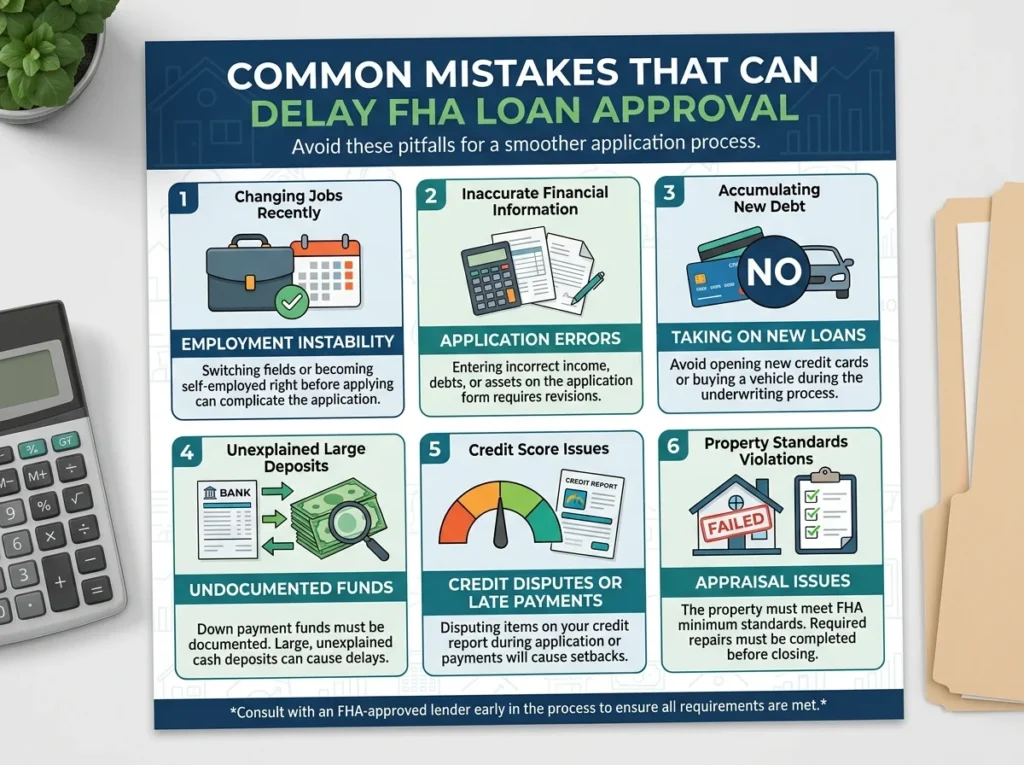
Even qualified borrowers can experience setbacks if they overlook important details during the approval process.
Avoid these common mistakes:
- Applying for new credit before closing
- Financing a vehicle or making large purchases
- Changing jobs during underwriting without informing your lender
- Missing requested documents
- Making large unexplained bank deposits
- Waiting until the last minute to gather paperwork
Careful financial planning before and during the mortgage process can improve your chances of a smooth approval.
Questions to Ask Before Choosing an FHA Lender
Selecting the right lender is just as important as choosing the right loan program.
Consider asking these questions before moving forward:
- How much experience do you have with FHA loans?
- Which loan options best fit my financial situation?
- What down payment options are available?
- What closing costs should I expect?
- How long does your average closing process take?
- Will I work with the same loan specialist throughout the process?
A lender who takes the time to communicate well and keep you in the loop at every step usually makes for a smoother home-buying process.
Who Benefits Most From FHA Home Loans?
FHA financing can be an excellent solution for many buyers, particularly those who:
- Are purchasing their first home
- Have limited savings for a down payment
- Are rebuilding their credit history
- Want flexible qualification requirements
- Need affordable home financing options
This is where an FHA Loan Specialist in California comes in to help you figure out if the FHA financing fits your home and financial needs.
Frequently Asked Questions
Who Qualifies for an FHA Loan?
FHA loans are designed for borrowers who meet the lender’s qualification requirements, including income verification, acceptable credit history, and debt-to-income guidelines. The home must also meet FHA property standards and generally be used as your primary residence.
How Much Down Payment Is Usually Required?
Most eligible borrowers are able to buy a home with only 3.5% down. The specific number will differ based on your financial background and lender standards.
Can I Use an FHA Loan More Than Once?
Yes. FHA loans are not just for first-time homebuyers. If you have a qualifying property and also meet the eligibility requirements for the program, then so long as it is your primary residence again, you can use FHA financing.
Are FHA Closing Costs Expensive?
Each home, lender, and loan amount has closing costs that need to be calculated. But FHA loans permit certain seller concessions that could help lower some of the out-of-pocket costs for eligible buyers.
Why Should I Work With an FHA Lender Instead of Applying Alone?
Hiring a skilled FHA mortgage broker in Orange County will make the mortgage process easier. A well-versed professional will assist in explaining loan alternatives, preparing your application, addressing questions during the approval process, and minimizing unnecessary setbacks.
Final Thoughts Before Applying for an FHA Loan
An FHA loan might be the right financing for buyers looking for flexible qualification standards, low down payments, and a proven system for ownership of their own home. Having an understanding of the loan, having all your financials squared away beforehand, and teaming up with a great mortgage pro can make for a far less painful process when buying.
Whether you are purchasing your first home or planning your next move, having experienced guidance can make a significant difference. At Nathan Carpenter, we are devoted to serving homebuyers through every step of your journey with our transparent process, customized guidance, and stability from preapproval to closing.
Get in touch with us today to discuss your maximum mortgage options and the next steps towards owning a home in Orange County.