
When you’re looking for a home in Santa Ana, you need more than just a good house. These factors can make a significant difference in your initial costs, monthly payment, and ownership costs, especially with the housing market in Orange County still at high prices.
For those who meet the criteria for conventional home loans in Santa Ana, it can be a viable choice for people who have a steady income and credit and have enough savings for the down payment and closing costs. They may be able to provide competitive terms without certain conditions that come with government financing.
What Is a Conventional Home Loan?
A conventional loan is a loan that’s not insured or guaranteed by the federal government. Many conventional mortgages are conforming loans as they adhere to the standards set by Fannie Mae and Freddie Mac.
Depending on the program, these loans may be available for a primary residence, a second home, or some investment properties. Borrowers can opt for a fixed-rate mortgage or an ARM if its payment structure suits their financial plans.
Conventional financing is especially relevant for buyers of homes in Santa Ana, as home prices in the area could call for higher loan amounts. Redfin reported a Santa Ana median sale price of about $849,575 in July 2026, up 4.9% from the previous year.
2026 Conventional Loan Requirements in Santa Ana

Qualification is subject to the borrower, property, loan program, and underwriting method. But there are some aspects to keep in mind when getting ready for a mortgage to buy a home.
Credit Score
The minimum credit score requirement for manually written Fannie Mae loans is typically 620 for fixed-rate mortgages and 640 for adjustable-rate mortgages, but may vary based on other factors in the underwriting process. Relying on one universal minimum score, automated underwriting by Desktop Underwriter examines the borrower’s entire profile.
A stronger credit profile can also help borrowers qualify for better pricing. Lenders typically check credit history, credit score, debt-to-income ratio, and other financial details.
Down Payment
There are conventional loan options that will accept a 3% down payment. For borrowers with especially low credit scores, for example, Freddie Mac’s Home Possible program provides as little as a 3% down payment. A bigger down payment will mean that you’ll have smaller monthly payments and loan amount. It can also be used to lower or even eliminate PMI if enough equity has been built up.
Debt-to-Income Ratio
Your debt-to-income ratio is a comparison of monthly debt payments to your qualifying income. The maximum DTI for desktop underwritten loans is 50% for Fannie Mae and 36% and 45% for manually underwritten loans, depending on the specified credit and reserve requirements. The qualifying ratio may change depending on the type of loan and financial situation.
What Are the 2026 Conforming Loan Limits?
The city of Santa Ana, situated in Orange County, California, is a high-cost housing market, and loan limits become important. For 2026, the conforming loan limit for a one-unit property in Orange County is $1,249,125. The limit increases to $1,599,375 for two units, $1,933,200 for three units, and $2,402,625 for four units.
If they exceed the conforming limit, they could end up being jumbo loans. This may be associated with variations in underwriting requirements, pricing, reserves, and qualification factors.
How Much Are Mortgage Rates in 2026?
Mortgage rates fluctuate often, so borrowers shouldn’t use an old mortgage rate ad to determine what they can afford. As of September 3, 2026, Freddie Mac reported a national average of 6.71% for a 30-year fixed-rate mortgage and 6.04% for a 15-year fixed-rate mortgage. The above are average rates for the country and not guaranteed Santa Ana rates. The actual rate may vary depending on credit, down payment, loan amount, property type, loan term, and other factors.
Benefits of Conventional Home Loans in Santa Ana
If you qualify for conventional financing, you may have a number of benefits.
Lower down payment options: All allowed programs must offer down payment amounts beginning at 3%, making homeownership more accessible to buyers without saving 20%.
Flexible property choices: Conventional loans are available for many primary homes, as well as for a variety of other qualified property types, depending on program guidelines and appraisal requirements.
PMI can eventually end: While certain types of mortgage insurance can stay in place for the life of the loan, conventional PMI can be eliminated when the equity requirements are met.
Potentially competitive pricing: Borrowers with good credit and finances could be offered a competitive loan price in relation to other loan financing choices.
Multiple loan structures: Purchasers may want to look at fixed-rate loans and adjustable-rate loans based on their objectives, risk tolerance, and the length of time they expect to hold the home.
Conventional Loans vs. FHA Loans in Santa Ana
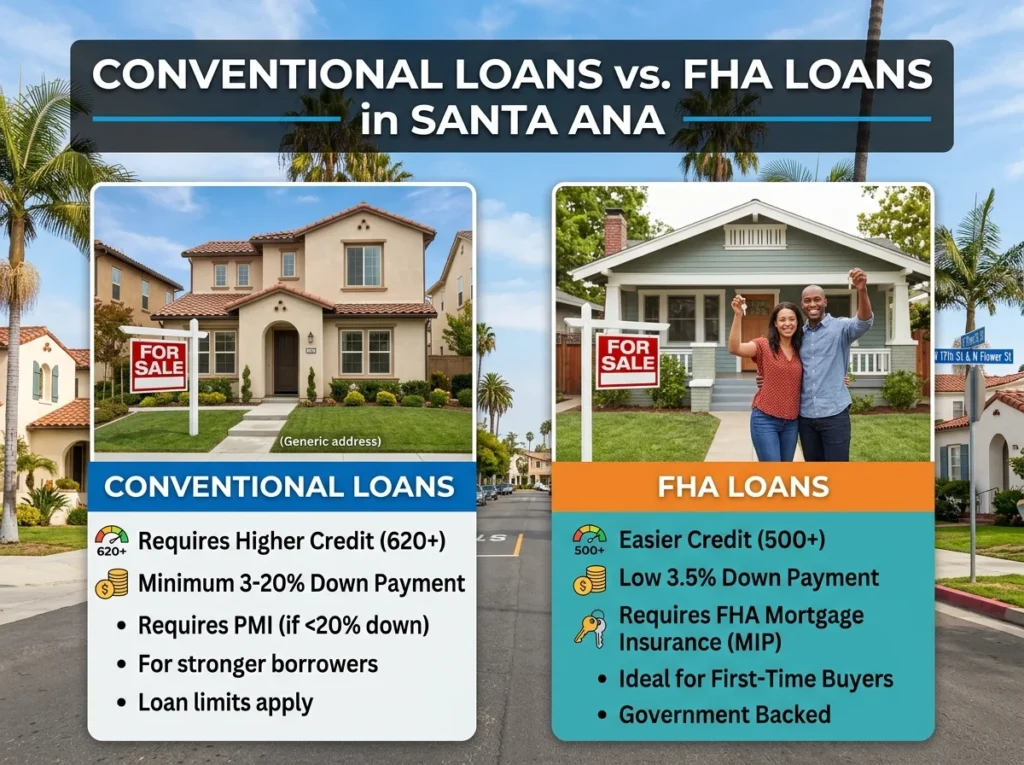
While both conventional and FHA financing options can help the buyer acquire a Santa Ana home, they’re different. Buyers comparing the two may also want to review this guide on FHA vs. conventional loans before deciding which financing option better fits their financial situation.
FHA loans are government-sponsored and can be beneficial for those with a few credit or down-payment problems. Conventional loans are non-government-financed and could appeal to purchasers with solid credit, steady finances, and the capacity to meet the requirements for a conventional mortgage without needing FHA mortgage insurance.
For context, the 2026 FHA one-unit loan limit can reach $1,249,125 in high-cost areas, but the applicable limit depends on the specific county. The best choice depends on the borrower’s complete financial situation rather than simply choosing the loan with the lowest advertised down payment.
What Documents Do Santa Ana Buyers Need?
The mortgage lender in Santa Ana will need documentation of support for income, assets, debts, employment, and property.
Common loan application documents can include:
- Government-issued identification
- Recent pay statements
- W-2 forms and tax returns when required
- Bank and investment account statements
- Employment and income information
- Details about existing debts
- Credit report authorization
- Purchase contract
- Information needed for the property appraisal
Other types of documentation may be required for a mortgage during underwriting if the self-employed borrower or applicant has income fluctuations.
How a Conventional Mortgage Works From Preapproval to Closing
Getting preapproved before shopping helps Santa Ana buyers figure out their budget and shows sellers that their financing is solid. Buyers can also learn more about working with a conventional loan broker when comparing financing options and preparing for the mortgage process.
Once an offer is accepted, the lender steps in to verify your financial info, order a property appraisal, check over the loan file, and finish up underwriting. After all that, you get your closing documents, including a Loan Estimate earlier in the process and a Closing Disclosure just before closing.
Santa Ana homes can cost quite a bit, so it’s not enough to know the purchase price. Buyers have to factor in the full monthly payment principal, interest, property taxes, homeowners insurance, HOA fees if they apply, and PMI.
Is a Conventional Loan Right for You?
A conventional loan advisor in Santa Ana can help you compare different mortgage loan programs based on your credit, income, down payment, target price, and long-term goals. For buyers who want personalized guidance through the process, Nathan Carpenter can help evaluate financing considerations and explain which conventional options may fit the purchase.
The right loan isn’t always the one with the smallest down payment. What matters more is finding a financing structure that fits your budget and keeps your total costs and monthly payments reasonable.
Frequently Asked Questions
What is the minimum credit score for a conventional loan?
There’s no one-size-fits-all minimum. Fannie Mae manual underwriting usually starts at 620 for fixed-rate loans and 640 for ARMs, while automated underwriting looks at your overall profile.
Can I get a conventional loan with 3% down?
Yes, some conventional programs let eligible borrowers put down as little as 3%. Eligibility depends on the exact program, the property, your income, credit, and other criteria. If your down payment is under 20%, you’ll almost always need PMI.
What is the 2026 conventional loan limit in Santa Ana?
For Orange County, the 2026 conventional cap for a one-unit home is $1,249,125. Higher limits exist for two-, three-, and four-unit properties.
Is a conventional loan better than an FHA loan?
Neither is automatically better. Conventional financing works well for buyers with strong credit and finances, while FHA loans can suit buyers who need different qualifications. Comparing the complete loan costs is more useful than comparing down payments alone.
Final Thoughts: Choosing Conventional Financing for a Santa Ana Home
With Santa Ana’s median home price sitting around $850,000 and the 2026 Orange County conforming limit at $1,249,125, conventional financing is a major option for local buyers.
Before applying, review your credit, income, debts, available cash, and expected monthly payment. Nathan Carpenter can help buyers understand their financing choices and approach the Santa Ana homebuying process with a clearer picture of what they can reasonably afford.